
If you’ve ever tried to run one bedtime routine for two children with completely different temperaments, you already know the problem: what settles one might wind the other one up. One wants the same book every night; the other’s bored by page two of anything familiar. One’s ready to sleep by seven; the other’s still negotiating at half past eight. Multiply the challenge of bedtime by however many children you have, and it stops being one routine — it becomes several, happening at once.
There’s no single fix for this, but a few shifts tend to make the evening feel less like triage.
Stagger, don’t synchronise
Trying to get every child through the exact same steps at the exact same time often means everyone’s slightly rushed and nobody gets the calm, unhurried version of bedtime. Staggering start times — even by fifteen or twenty minutes — gives each child a stretch where they’re not competing for your attention, and gives you a chance to actually adjust your approach per child rather than running one routine on autopilot.
Let each child’s story be genuinely theirs
Reading the same book to two children with different interests and different attention spans is a real balancing act — pitched right for one, it’s often wrong for the other. A story that’s shaped around each child individually removes that tension entirely: one gets a calm, familiar-feeling adventure while the other gets exactly the kind of excitement they’re after, without either of them having to sit through a story that wasn’t really built for them.
Protect one-on-one time, even briefly
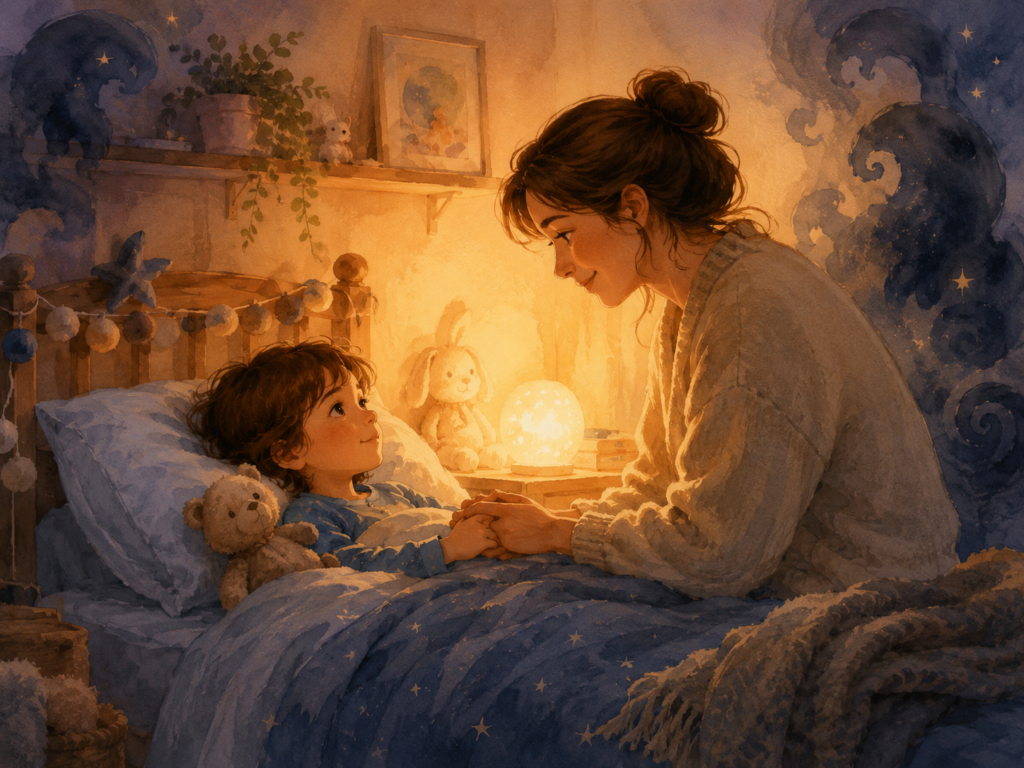
In a busy multi-child bedtime, it’s easy for the routine to become entirely logistical — teeth, pyjamas, lights, next child, repeat. Even five uninterrupted minutes of individual attention per child, story time or otherwise, tends to do more for a calm bedtime than a perfectly efficient schedule with none.
Older siblings don’t always want to feel “grown out of” the routine
It’s tempting to assume an older child has outgrown story time once a younger sibling arrives, but many older children still want that same connection — they just want it to feel a little more their age. Adjusting a story’s tone or complexity for an older child, rather than dropping story time altogether, can keep that part of the routine meaningful for everyone a bit longer than expected.
Some nights, “good enough” bedtime is the win
With more than one child, a perfectly smooth bedtime is the exception, not the rule. Some nights the wins are smaller than you’d like — nobody’s crying, everyone’s eventually in bed, and that’s a completely reasonable outcome to be satisfied with.
With a profile for each child, Pillow builds a story shaped around who they are — so siblings with completely different personalities can each get a bedtime story that actually fits.





Leave a Reply