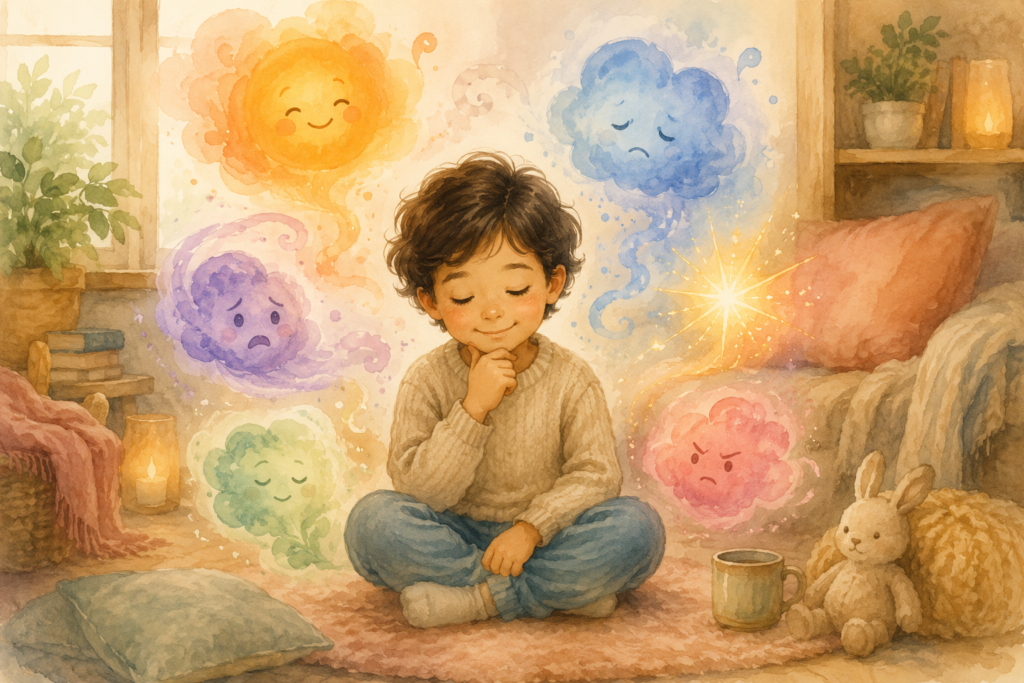
Young children feel things intensely, long before they have the words to describe what’s happening. “I’m mad” or “I don’t like it” often has to stand in for something far more specific — disappointment, embarrassment, worry, jealousy — simply because the more precise words haven’t been learned yet. Building that vocabulary is one of the quieter, less obvious benefits of regular storytelling.
Stories give feelings a name, in context
When a character in a story feels nervous before trying something new, or disappointed when a plan falls through, children absorb not just the word but the situation it belongs to. That contextual learning tends to stick better than a word taught in isolation — a child who’s heard a character described as “nervous” while waiting for something exciting has a much clearer sense of what that word actually means than one who’s simply been told the definition.
It’s easier to talk about a character’s feelings than your own
For a young child, discussing why a story character feels sad or frightened is often far less loaded than discussing their own recent meltdown or fear. That slight distance makes it a safer entry point for talking about difficult emotions — a conversation about a nervous character can gently open the door to a child recognising and naming that same nervousness in themselves, without it feeling like they’re being questioned about their own behaviour.
Repetition across many stories builds a richer emotional map
No single story does this work on its own — it’s the accumulation, over many stories and many characters, of encountering the same emotions described slightly differently each time (nervous, worried, uneasy, on edge) that gradually builds a child’s ability to reach for a more precise word instead of defaulting to “I’m mad” or “I don’t like it” for almost everything.
Personalised stories can meet a child’s specific emotional moment
A generic story picks its themes in advance, with no idea what a specific child is actually feeling that day. A story that can be shaped around tonight’s mood — a bit nervous about school tomorrow, a bit lonely, a bit overexcited — has the chance to model exactly the emotional vocabulary that’s most relevant to that child, right when it’s most useful.
This is a long game, not a quick fix
Emotional vocabulary builds gradually, over months and years of exposure, not from any single story or conversation. The value of making this part of a regular bedtime routine isn’t a single breakthrough moment — it’s a steady, low-pressure supply of language a child can draw on, a little more precisely, each time something big comes up.
Every Pillow story can be shaped around your child’s mood that night — a gentle way to give big feelings some useful words, night after night. Try a story shaped around your own child, free for 14 days.




Leave a Reply